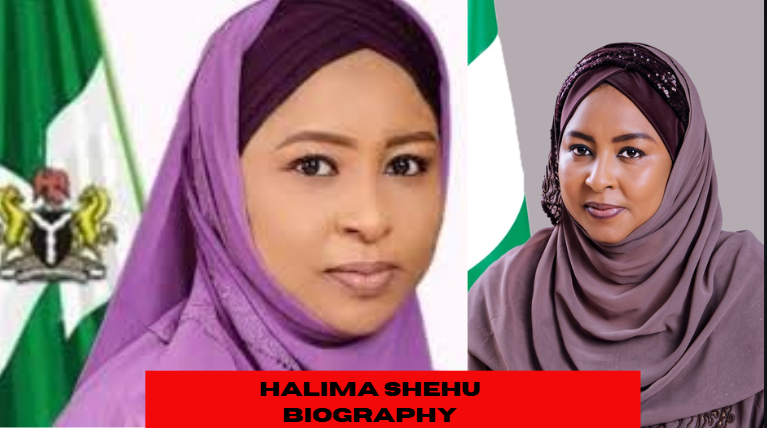
In Nigerian public life, it is rare to find someone who has moved credibly between the precision of banking, the complexity of diplomacy, and the human-facing demands of social intervention work. Halima Shehu is one of those rare figures. A career professional from Kafin Dagi village in Katsina State, she spent years building expertise across finance and international affairs before stepping into one of the more consequential public service roles in recent Nigerian history.
In October 2023, the Nigerian Senate confirmed her as the National Coordinator of the National Social Investment Programme Agency (NSIPA) — a body responsible for some of Nigeria’s largest poverty alleviation and welfare programmes. That confirmation was not just a career milestone. It placed her at the intersection of government policy and the daily realities of millions of vulnerable Nigerians who depend on social safety nets to survive.
Understanding who Halima Shehu is requires looking at the full arc of her journey — from a primary school in Katsina to the boardrooms of Nigerian banking, and eventually to the policy corridors of Abuja.
Halima Shehu Biography
| Detail | Information |
|---|---|
| Full Name | Hajia Halima Shehu |
| Year of Birth | 1973 |
| Age (as of 2026) | 53 years old |
| Nationality | Nigerian |
| State of Origin | Katsina State |
| Hometown | Kafin Dagi Village, Katsina |
| Ethnicity | Hausa-Fulani |
| Tribe | Hausa |
| Religion | Islam |
| Profession | Public Servant, Banker, Politician |
| Current Role | National Coordinator, NSIPA |
| Political Affiliation | Not publicly specified |
| Education | ABU Zaria – BA English; MA International Affairs & Diplomacy |
| @sadeeya_yarima | |
| Net Worth | Not publicly confirmed |
Early Life and Background
Halima Shehu was born in 1973 in Kafin Dagi, a village in Katsina State in northwestern Nigeria. Katsina is one of Nigeria’s historically significant states — a region with deep roots in Islamic scholarship, trans-Saharan trade, and Hausa-Fulani political culture. Growing up there in the 1970s and 1980s meant coming of age in a community where education, particularly for girls, was increasingly valued but not always easily accessed.
The fact that Shehu pursued formal education from an early age, moving from primary school through secondary school and on to one of Nigeria’s most respected universities, places her within a generation of northern Nigerian women who quietly but persistently carved out professional space in a landscape that didn’t always make it easy.
Her early formation in Katsina — a state known for producing disciplined, policy-minded public figures — seems to have instilled in her a grounded sense of institutional service that would define her career choices across multiple decades.
Education
Shehu’s educational journey is one of the more substantive aspects of her profile, and it reflects someone who invested seriously in her own intellectual development across different stages of life.
She began at Ambuttai Primary School in Katsina — now renamed Musa Yar’adua Primary School in honour of the former Nigerian President who hailed from the state — where she completed her First School Leaving Certificate. She then moved to the Federal Government College in Kaduna, a federal unity school that drew students from across Nigeria, for her secondary education, graduating with her West African Examination Certificate (WAEC).
For her undergraduate degree, she attended Ahmadu Bello University (ABU) in Zaria — Nigeria’s largest university and one of its most academically prestigious institutions. She graduated with a Bachelor of Arts in English Language, a discipline that sharpens analytical thinking, communication, and critical reading — skills that translate powerfully into both banking compliance work and public administration.
She later returned to ABU for postgraduate study, earning a Master’s degree in International Affairs and Diplomacy. This second qualification is particularly telling: it signals an ambition that extended well beyond domestic banking operations, toward understanding how states, institutions, and international frameworks interact.
Throughout her banking career, she layered additional professional training on top of her academic base — covering banking operations, customer service, compliance, auditing, and financial technology. This combination of formal education and applied professional development gave her a profile that was unusually well-rounded for someone who would eventually transition into social policy leadership.
Career Journey
Starting in the Financial Sector
Shehu began her professional life in the Nigerian banking sector — a demanding environment that, particularly from the 1990s through the 2000s, was undergoing rapid transformation. Nigerian banks during this period were expanding aggressively, professionalising their operations, and navigating the regulatory changes that followed major sector reforms.
Working in this environment required more than a good degree. It demanded adaptability, compliance awareness, and the ability to work across customer-facing and back-office functions. Shehu’s training records indicate she developed competencies across a broad range of banking disciplines: operations, customer service, audit, compliance, and emerging financial technology. This breadth suggests someone who moved through different areas of banking rather than staying confined to one function — a professional pattern that tends to produce generalists capable of institutional leadership.
Transition Into Public Life
The transition from banking to public service is not uncommon in Nigeria, particularly for professionals with strong administrative and financial backgrounds. What made Shehu’s transition notable was the seniority of the role she stepped into. Her appointment as National Coordinator of NSIPA — subject to Senate confirmation — was not an entry-level public service posting. It was a leadership appointment with national reach and real accountability.
The National Social Investment Programme Agency oversees some of Nigeria’s most significant welfare initiatives, including programmes designed to reach the poorest and most vulnerable households across the country. Managing such an institution requires someone who understands financial systems, can work with government bureaucracy, and appreciates the human dimension of poverty alleviation. Shehu’s combined background in banking and international affairs diplomacy made her a credible fit for that brief.
Senate Confirmation and NSIPA Leadership
In October 2023, the Nigerian Senate formally confirmed Halima Shehu as NSIPA’s National Coordinator. Senate confirmations in Nigeria are not automatic — nominees are typically screened, their qualifications reviewed, and their suitability debated. Her successful confirmation signalled that her professional record withstood scrutiny at the highest legislative level in the country.
Since assuming the role, she has been responsible for coordinating the implementation of social investment programmes that touch millions of Nigerian lives — from conditional cash transfer schemes to programmes targeting youth employment and nutrition. The scope of this responsibility places her among the more consequential mid-level public administrators in the current Nigerian government.
Influence, Leadership Style, and Contributions
What distinguishes Shehu’s profile from many Nigerian public servants is the combination of technical financial expertise and policy-level responsibility. In a sector — social investment — that often struggles with transparency, targeting accuracy, and leakage of funds, having a National Coordinator with a banking background in compliance and auditing carries real significance.
Her academic training in international affairs also brings a comparative perspective to her work: an awareness that social protection systems in other countries offer lessons that Nigeria’s programmes can learn from. Whether that intellectual background actively shapes her management of NSIPA is something only those working closely with the agency can assess, but it forms a credible part of her professional DNA.
Her presence as a woman from Katsina in a senior federal government role also carries quiet symbolic weight. Northern Nigerian women in high-visibility public administration roles remain underrepresented relative to their southern counterparts, and Shehu’s career trajectory — built on education and professional consistency rather than political patronage alone — offers a model worth noting.
Personal Life
Halima Shehu carries the title “Hajia,” which indicates she has performed the Hajj pilgrimage to Mecca — a significant marker of faith and community standing within Nigerian Muslim society. Her religion is Islam, consistent with the predominant faith of Katsina State and the broader Hausa-Fulani community she comes from.
Details about her spouse, children, or immediate family have not been publicly confirmed in verified sources, and this article will not speculate where solid information does not exist. What comes through from her public profile is a person who has prioritised professional development and public service across a long career — a dedication that typically leaves its own kind of personal mark on a life.
She maintains an Instagram presence under the handle @sadeeya_yarima, where followers can find more personal updates directly from her.
Net Worth
Halima Shehu’s net worth has not been publicly confirmed, and no widely verified figure exists in the public domain. Her income across her career would have been primarily derived from her banking salary over the years and, more recently, from her remuneration as a federal government appointee in the role of NSIPA National Coordinator. Public service positions in Nigeria at this level carry government-scale compensation rather than private sector executive packages. Any specific wealth figures circulating online should be treated as unverified.
Conclusion
Halima Shehu’s career is not the kind that generates headlines every week, but it represents something that Nigerian public life genuinely needs: professionals with deep technical expertise who eventually bring that expertise to bear on government and social policy. Her path from a village in Katsina to heading one of Nigeria’s key social investment agencies is a story of sustained, disciplined professional growth across multiple fields.
The real test of her contribution will be measured not in titles or appointments, but in whether the programmes under NSIPA’s coordination under her watch actually reach the Nigerians they are designed to serve. That accountability — unglamorous but essential — is the arena in which her legacy will ultimately be written.
FAQs
1. Who is Halima Shehu? Hajia Halima Shehu is a Nigerian public servant, banker, and politician from Kafin Dagi village in Katsina State. She was confirmed by the Nigerian Senate in October 2023 as the National Coordinator of the National Social Investment Programme Agency (NSIPA).
2. How old is Halima Shehu? She was born in 1973, making her 53 years old as of 2026.
3. Where did Halima Shehu study? She attended Ambuttai Primary School in Katsina, Federal Government College Kaduna, and went on to earn a BA in English Language and an MA in International Affairs and Diplomacy from Ahmadu Bello University (ABU), Zaria.
4. What is Halima Shehu’s role in the Nigerian government? She serves as the National Coordinator of the National Social Investment Programme Agency (NSIPA), a federal body responsible for coordinating Nigeria’s social welfare and poverty alleviation programmes.

Samuel Akinsola is a biography writer and researcher dedicated to uncovering inspiring life stories. He creates well-researched profiles that highlight achievements, challenges, and lasting legacies.