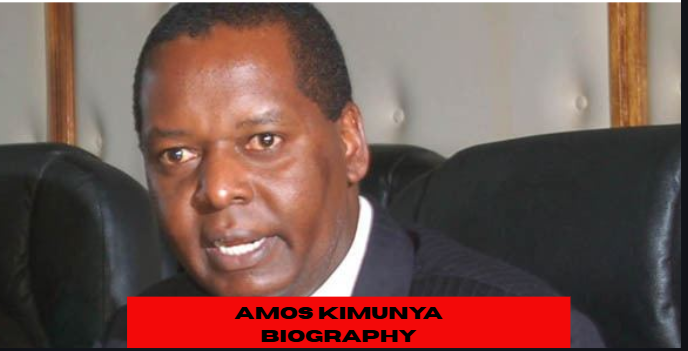
There are politicians who leave office quietly, and there are those whose exits carry the weight of a story finally reaching its conclusion. Amos Kimunya belongs firmly in the second category. For over a decade, Kenya’s former Finance Minister and Kipipiri MP carried the dual burden of a distinguished public service record and a corruption case that shadowed his every move. When a Kenyan court acquitted him in May 2026, Kimunya didn’t celebrate with a political comeback announcement. Instead, he did something that surprised many observers — he walked away from politics entirely.
That decision says a great deal about the man. Kimunya has spent the better part of three decades in the corridors of Kenyan power, moving through some of the most consequential ministerial portfolios in the country’s recent history. He served during critical periods — economic reform, post-election tension, infrastructure expansion — and survived controversies that would have permanently ended lesser careers. His story is one of resilience, institutional knowledge, and an ultimately vindicated reputation.
Understanding Amos Kimunya means understanding a particular generation of Kenyan technocrat-politician: educated, ambitious, ideologically pragmatic, and deeply embedded in the machinery of government.
Amos Kimunya Biography
| Detail | Information |
|---|---|
| Full Name | Amos Muhinga Kimunya |
| Age | 64 years old (as of 2026) |
| Nationality | Kenyan |
| Profession | Politician, Economist, Former Cabinet Minister |
| Political Party | Jubilee Party (formerly PNU) |
| Constituency | Kipipiri (former MP) |
| Education | Doctorate (PhD) |
| Spouse | Late Lucy Wanjiru Kimunya |
| Religion | Christian |
| Tribe | Kikuyu |
Early Life and Background
Amos Kimunya was born in Kenya in 1962, coming of age during a period of enormous political and economic transformation in the country. The Kenya he grew up in was still finding its footing as an independent nation, navigating the complex politics of single-party rule under President Daniel arap Moi while simultaneously trying to build a functioning modern economy.
Kimunya’s background placed him within the Kikuyu community, one of Kenya’s largest and most politically active ethnic groups, whose relationship with power and governance has been central to the country’s political narrative since independence. Growing up in this context, politics and public affairs were never abstract concepts — they were lived realities that shaped communities and determined opportunities.
What set the young Kimunya apart was an aptitude for economics and finance. While many of his peers gravitated toward law or medicine as the prestigious paths to influence, Kimunya saw numbers and policy as his tools. This orientation toward economic thinking would define the trajectory of his entire public life.
Education
Kimunya pursued his academic training with the same methodical focus he would later bring to government. He built a strong foundation in economics and finance, eventually earning a doctorate — a qualification that speaks to a level of intellectual commitment beyond what is typically required for political life in Kenya.
For years, this doctorate sat somewhat dormant in the background of his career, overshadowed by his work in government and parliament. However, following his acquittal in 2026, Kimunya was candid about the fact that his legal battles had prevented him from fully deploying his academic credentials.
“I couldn’t do that while appearing in court because students would wonder whether they are being taught by a guilty person or an accused,” he said, reflecting on the years he felt unable to step into lecture rooms.
His educational background wasn’t merely decorative. It informed his approach to fiscal policy during his time as Finance Minister and gave him a credibility in economic matters that many of his political contemporaries lacked.
Career Journey
From Finance to the Cabinet
Kimunya’s path into public life was built on professional expertise rather than grassroots political organizing. He established himself in Kenya’s financial sector before transitioning into government, bringing with him a technical grounding that distinguished him from politicians who came up purely through party structures.
His first major national role came when he was appointed to the Cabinet under President Mwai Kibaki, initially serving as Minister for Lands and Settlement. It was a portfolio that placed him at the center of one of Kenya’s most contentious political issues — land ownership and distribution — a subject with deep historical, ethnic, and economic dimensions.
Finance Ministry and the Grand Mortgage Controversy
The defining chapter of Kimunya’s ministerial career was his tenure as Minister for Finance. He became one of the most powerful economic decision-makers in the country during a period when Kenya was simultaneously managing post-2007/2008 election violence recovery, seeking investor confidence, and attempting structural reforms.
It was during this period that the Grand Regency Hotel sale controversy brought him crashing into public scrutiny. The sale of the government-linked hotel — at a price many Members of Parliament considered grossly undervalued — triggered a parliamentary motion of no confidence. Kimunya resigned from the Finance Ministry in 2008, a moment that many observers assumed would mark the end of his political career.
It did not.
The Comeback and Parliamentary Career
In a remarkable demonstration of political durability, Kimunya was reappointed to the Cabinet — first as Minister for Trade and then as Minister for Transport — under successive administrations. His ability to return to influence after a forced resignation spoke to both his personal resilience and his value to those in power as a technically competent operator.
He later transitioned to elected politics, winning the Kipipiri parliamentary seat in Nyandarua County. As an MP, he served in various capacities within the National Assembly, including as Majority Leader — one of the most senior positions available to a member of parliament, responsible for coordinating government business in the House.
The Graft Case and Its Shadow
Running parallel to his political career was a corruption case that dogged him for over twelve years. The case stemmed from allegations related to his time in the Finance Ministry. For more than a decade, Kimunya appeared in court, maintained his innocence, and continued serving in public roles — an unusual combination that reflected both Kenya’s sometimes slow judicial process and the complex relationship between legal proceedings and political eligibility in the country.
The May 2026 acquittal brought that chapter to a formal close. Speaking outside the court, Kimunya described it as “a culmination of 12 years of suffering for something we did not do.”
Leadership Style and Contributions
Kimunya was never a populist politician in the mould of leaders who built their brands on mass rallies and fiery rhetoric. His style was quieter, more institutional. He operated effectively in the boardroom and the budget chamber more than on the campaign trail.
His contribution to Kenyan economic policy, particularly during the Kibaki-era growth period, was substantive. Kenya experienced consistent GDP growth during the late 2000s, and while Kimunya cannot claim sole credit for this trajectory, his management of the Finance Ministry during a particularly turbulent period — political instability, global financial crisis ripple effects, investor anxiety — showed a capacity for steady stewardship under pressure.
As Majority Leader in parliament, he was responsible for managing complex legislative agendas, building consensus among ruling coalition MPs, and navigating the sometimes fractious dynamics of Kenya’s National Assembly. These are not glamorous roles, but they are essential ones, and Kimunya performed them with the competence of someone who understood how institutions actually function.
Personal Life
Marriage and the Loss of Lucy Wanjiru
Behind the public figure was a private man who experienced profound personal loss. Kimunya was married to Lucy Wanjiru Kimunya, a woman he described with clear affection. Lucy passed away, leaving Kimunya to navigate his later public years as a widower — a grief that rarely surfaced in his public statements but was undoubtedly present throughout the years of legal battles and political turbulence.
The combination of his wife’s passing and the prolonged court case gives the period from roughly 2013 to 2026 a particular weight when you consider the full arc of his personal life. Kimunya himself referred to those years as ones of “personal and professional suffering.”
Family and Private Life
Kimunya has maintained considerable privacy around his children and extended family, which is in keeping with his generally understated personal style. He has not made his family a centerpiece of his public image, preferring to keep that dimension of his life away from the political spotlight.
Faith
Kimunya identifies as a Christian, and like many Kenyan public figures of his generation, faith has been a consistent, if quietly expressed, dimension of his personal identity.
Net Worth
Kimunya’s precise net worth has never been publicly confirmed or officially disclosed. What is known is that his wealth, such as it is, derives primarily from a long career in government service, his professional background in finance, and likely various private sector engagements over the decades. Kenyan Cabinet ministers and senior MPs receive significant remuneration, and Kimunya’s tenure across multiple high-ranking positions over nearly three decades would have provided substantial accumulated earnings.
It would be inaccurate — and irresponsible — to state a specific figure without verified data. What can be said is that he is a man of comfortable means, as is consistent with someone of his professional trajectory.
Life After Politics: The Next Chapter
Perhaps the most revealing thing Amos Kimunya has said in his entire public career came in May 2026, moments after his acquittal. Asked about his plans, he didn’t hint at a return to elective office or suggest he was positioning himself for a future appointment. He said he wanted to teach.
“I would like now to mentor the young generation. You might find me in some lecture rooms using my doctorate, knowledge,” he said.
For someone who spent decades at the center of Kenyan political power, this was a notably humble and human ambition. It suggests a man who, having finally shed the legal cloud that followed him for twelve years, is ready to contribute differently — not through legislation or budget speeches, but through conversation, teaching, and the transmission of hard-won experience to the next generation.
Whether he follows through on this intention remains to be seen. Kenyan politics has a way of drawing people back. But the clarity and lightness with which Kimunya spoke after his acquittal — “I am free to pursue other pursuits in life, of course not politics anymore” — suggested that for now, at least, he means it.
Social Media
- Twitter/X: Search @AmosKimunya for official updates
- Facebook: Amos Kimunya — Official Page
(Note: Always verify accounts for authenticity before engaging.)
FAQs
Q1: Why did Amos Kimunya leave politics? Following his acquittal in a graft case in May 2026 — a case that had run for over twelve years — Kimunya publicly stated that he has no intention of returning to elective politics. He indicated his priorities have shifted toward teaching, mentorship, and academic engagement.
Q2: What was Amos Kimunya’s most important government role? His tenure as Minister for Finance under President Mwai Kibaki is widely considered his most consequential role. He managed Kenya’s fiscal policy during a particularly complex period, including the aftermath of the 2007/2008 post-election crisis.
Q3: What happened with the Grand Regency Hotel scandal? Kimunya faced parliamentary backlash over the sale of the Grand Regency Hotel, which critics alleged was sold at below-market value. He resigned from the Finance Ministry in 2008, though he consistently denied wrongdoing and was eventually acquitted of related charges in 2026.
Q4: Is Amos Kimunya still married? His wife, Lucy Wanjiru Kimunya, has passed away. Kimunya is a widower.
Q5: What does Amos Kimunya plan to do after his court acquittal? He has expressed a clear desire to move into teaching and mentorship, intending to use his doctorate and decades of professional experience to guide young professionals and students in academic settings.

Samuel Akinsola is a biography writer and researcher dedicated to uncovering inspiring life stories. He creates well-researched profiles that highlight achievements, challenges, and lasting legacies.