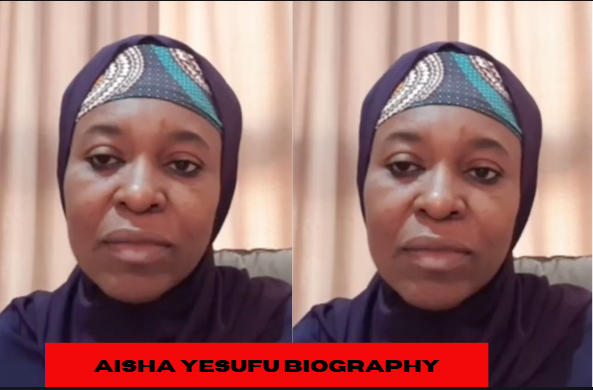
Who Is Aisha Yesufu? There is a particular kind of courage that does not announce itself — it simply shows up, again and again, in the places where most people have already decided to look away. Aisha Yesufu has that kind of courage. She became one of Nigeria’s most recognisable faces during the 2020 #EndSARS protests, captured in a now-iconic photograph — fist raised, headscarf vivid, expression unyielding — that came to symbolise something larger than any single demonstration. But to reduce her to that image would be to misunderstand her entirely.
Aisha Yesufu is a civil society activist, co-convener of the Bring Back Our Girls movement, businesswoman, and now a declared aspirant for the FCT Senate seat ahead of Nigeria’s 2027 general elections. She has spent decades operating in spaces where Nigerian women, particularly those from conservative upbringings, were not expected to have opinions — let alone demand accountability from governments. That she has done so persistently, and with increasing influence, is a story worth telling properly.
Aisha Yesufu Biography
| Detail | Information |
|---|---|
| Full Name | Aisha Somtochukwu Yesufu |
| Nationality | Nigerian |
| State of Origin | Agbede, Edo State |
| Place of Birth/Upbringing | Kano State, Nigeria |
| Religion | Islam |
| Profession | Activist, Civil Society Leader, Businesswoman, Senate Aspirant |
| Known For | #EndSARS, Bring Back Our Girls |
| Twitter/X | @AishaYesufu |
Early Life and Background
Aisha Somtochukwu Yesufu was born and raised in Kano State — one of Nigeria’s most populous northern cities, shaped heavily by Islamic tradition and deeply patriarchal social structures. Her family’s roots, however, lie in Agbede, a town in Edo State in southern Nigeria. That combination — a southern Nigerian heritage lived out within a conservative northern context — is an important lens through which to understand who she became.
Growing up female in that environment was not without its costs. By the time Aisha was eleven years old, she no longer had a single female friend her age. Not because of any falling out or social difficulty, but because her peers had either been married off or had died in childbirth. That is not a metaphor or an exaggeration — it is the kind of lived reality that shapes a person’s worldview at the most formative level.
For many young girls in similar circumstances, that environment produces resignation. For Aisha, it appears to have produced the opposite: a refusal to accept that the conditions around her were natural or inevitable. The early loss of her peers to child marriage and preventable maternal death seems to have planted the seed of what would become a lifelong commitment to speaking up for those the system ignores.
Her name itself is layered — Aisha, Arabic in origin and common in Muslim communities across northern Nigeria, combined with Somtochukwu, an Igbo name meaning “praise God with me.” That duality — north and south, Hausa-Islamic environment and Igbo-Edo lineage — gives her a cultural complexity that she has never tried to paper over.
Education
Specific details about Aisha Yesufu’s formal academic qualifications have not been extensively documented in public sources. What is evident, however, is that she is sharply analytical, articulate across multiple platforms, and capable of engaging complex policy, legal, and political arguments with precision. Whether those skills came from formal institutions, self-directed learning, or lived experience in civic spaces — or most likely all three — they are visible in every interview and public engagement she undertakes.
Career: From Civic Frustration to National Icon
Aisha Yesufu did not begin her public life as a politician or a celebrity activist. She came to prominence through sustained, unglamorous civil society work — the kind that rarely makes headlines until a crisis arrives and journalists need someone who actually understands the issues.
Her involvement with the Bring Back Our Girls movement marked one of her most sustained public engagements. When over 270 schoolgirls were abducted from Chibok in Borno State by Boko Haram in April 2014, a movement of grieving, outraged Nigerians formed to demand government action. Aisha became one of its most visible co-conveners — showing up, day after day, when media attention had moved on and government interest had cooled. That consistency — not just turning up for the cameras but staying committed over years — is what distinguished her from many who passed through the movement.
Then came October 2020. The #EndSARS protests, triggered by viral footage of brutality by Nigeria’s Special Anti-Robbery Squad, became the largest youth-led demonstration in Nigerian history. Aisha Yesufu was there — not as an organiser managing events from a safe distance, but physically present at the Lekki toll gate in Lagos, standing alongside young Nigerians who had taken to the streets despite the risks. The photograph taken of her that day — resolute, visible, unafraid — circulated globally and became one of the defining images of that protest movement.
It would have been easy to let that moment define her. She did not.
She continued to engage critically with Nigerian governance, using her platform — particularly on social media — to hold officials accountable, challenge misinformation, and amplify the voices of ordinary Nigerians. She has never been particularly interested in the kind of activism that stays safely in abstraction.
The 2027 Senate Bid
In May 2026, Aisha Yesufu confirmed her intention to contest the FCT Senate seat in Nigeria’s 2027 general elections. Speaking on Channels Television’s Politics Today, she was direct about her approach: she would not engage in electoral malpractice, but she would not be a pushover either.
“I will not do any illegality. I am not going to steal anybody’s vote,” she said, “but if I am able to clinch my party ticket and we get to the general election, anyone who thinks they will rig the vote that the people have given me, will know that when they go low, I will go underground.”
It is the kind of statement that sounds combative on the surface but is actually a precise articulation of democratic principle — protecting the will of voters, not threatening violence. She expressed confidence in FCT residents, arguing that Abuja voters have historically been resistant to imposition from political godfathers. Whether or not her electoral bid succeeds, the fact that she is taking it seriously — on her own terms — is consistent with everything she has done publicly.
Leadership Style and Influence
Aisha Yesufu’s influence does not operate through quiet diplomacy or institutional gatekeeping. She is a confrontational activist in the most constructive sense of that word — she names problems directly, challenges power publicly, and does not soften her positions to avoid controversy.
What makes her effective is not just her willingness to speak, but her consistency. She has been at this for years, and her record of engagement is long enough to be evaluated against itself. She has not drifted with the political winds or attached herself to whichever administration was offering proximity to power. That independence is increasingly rare in Nigerian public life, and it is a significant part of why she remains credible.
Her social media presence, particularly on X (formerly Twitter) at @AishaYesufu, functions as a real-time civic engagement platform. She uses it to respond to breaking news, challenge government narratives, and engage directly with followers — often at a pace and depth that most public figures, let alone politicians, do not match.
Personal Life: Family and Faith
Aisha Yesufu is married, and her husband has been a quiet but steady presence in her public narrative — someone she has referenced as supportive of her activism, even when it created personal risk. She is a mother, though she has maintained a degree of privacy around her children, which is a reasonable and understandable boundary for someone whose public engagements have occasionally attracted hostility.
Her faith is Muslim, and it is a visible part of her identity — she wears a hijab publicly and has spoken about how her values are informed by her beliefs. Importantly, she does not position her religion as a barrier to women’s rights or civic participation; quite the opposite. Her activism has always been rooted in the idea that justice and accountability are obligations, not optional extras.
Net Worth
Aisha Yesufu’s exact net worth has not been publicly confirmed and should not be speculated upon. Her income has primarily come from her business activities and, more recently, her public speaking and civic engagements. She is not a figure who has monetised her activism in any conspicuous way, and no verified financial disclosures are currently available.
Conclusion
What Aisha Yesufu represents in Nigerian public life is something that is genuinely difficult to manufacture: a track record. She was not created by a single viral moment — she existed before it, and she has continued long after it. Her decision to move from civil society into electoral politics in 2027 is either the natural next step for someone who has spent decades demanding better governance, or a test of whether the system she has long critiqued can accommodate someone like her within it. Either outcome will be instructive. Follow her on X at @AishaYesufu to keep up with her next moves.
FAQs
1. What is Aisha Yesufu known for? She is best known as a co-convener of the Bring Back Our Girls movement and as a prominent face of the 2020 #EndSARS protests in Nigeria, where a photograph of her became globally recognised.
2. Where is Aisha Yesufu from? Her family originates from Agbede in Edo State, though she was born and raised in Kano State in northern Nigeria.
3. What religion does Aisha Yesufu follow? She is Muslim and publicly identifies with her faith, including wearing a hijab in all her public appearances.
4. Is Aisha Yesufu running for political office? Yes. As of 2026, she has declared her intention to contest the FCT Senate seat in Nigeria’s 2027 general elections.
5. Is Aisha Yesufu married? Yes, she is married. She has spoken about her husband in supportive terms in various interviews, though she maintains privacy around the details of her family life

Samuel Akinsola is a biography writer and researcher dedicated to uncovering inspiring life stories. He creates well-researched profiles that highlight achievements, challenges, and lasting legacies.