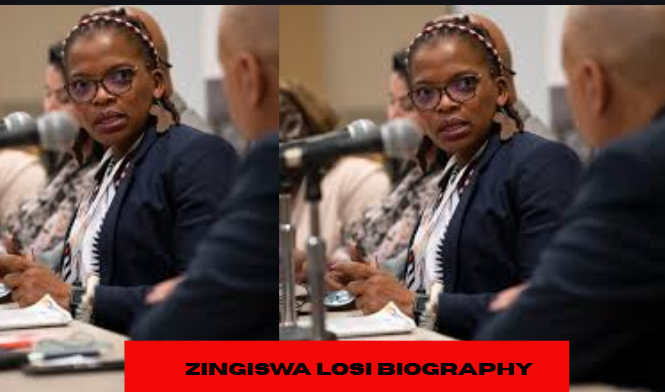
There are few figures in South African public life whose rise carries the kind of weight that Zingiswa Losi‘s does. She didn’t arrive at the top of one of Africa’s most powerful trade union federations through political inheritance or institutional shortcuts. She got there through decades of grassroots organizing, strategic resilience, and an almost stubborn commitment to workers’ rights — starting from a working-class township in the Eastern Cape.
When Losi was elected president of the Congress of South African Trade Unions (COSATU) in September 2018, she became the first woman to hold that position in the federation’s history. That milestone alone would be enough to cement her place in South African labor history. But what makes her story genuinely compelling is everything that came before it — and the turbulent internal politics she had to survive to get there.
Zingiswa Losi Biography
| Detail | Information |
|---|---|
| Full Name | Zingiswa Phyllis Losi |
| Date of Birth | 2 October 1975 |
| Age | 50 years old (as of 2025) |
| Place of Birth | KwaZakhele, Eastern Cape, South Africa |
| Nationality | South African |
| Profession | Trade Unionist, Politician |
| Current Role | President, COSATU |
| Political Party | ANC; SACP (Central Committee Member) |
| Education | Algoa College of Education; UNISA (Economics, incomplete) |
| Children | Two adult daughters |
| Social Media | Twitter/X: @ZingiswaLosi |
Early Life and Background
Zingiswa Losi was born on 2 October 1975 in KwaZakhele, a township in what was then known as the Cape Province. When she was barely a year old, her family relocated to New Brighton, a neighboring township just outside Port Elizabeth (now Gqeberha). It’s a small geographic distinction that carries a lot of cultural weight — New Brighton is one of the oldest Black townships in South Africa, and growing up there in the 1980s meant growing up inside the heartbeat of the anti-apartheid struggle.
Her parents were working-class people in the truest sense. Her father, Graham Mzwandile Losi, worked as a general assistant at a hospital and later as a debt collector at a furniture shop. Her mother, Vuyiswa Esther Losi, was a domestic worker who eventually also became a hospital general assistant. Zingiswa was one of nine children — a large family navigating modest means in a politically charged environment.
Two of her older siblings fled into exile with the anti-apartheid movement in 1985 and 1986, which tells you something about the Losi household’s political atmosphere. It wasn’t abstract activism — it was personal. Zingiswa herself became active in the Congress of South African Students (COSAS) as a teenager, absorbing the organizational culture of resistance at a formative age. She also has a twin sister named Zamela, a detail that humanizes a figure who is often discussed primarily through institutional roles.
She attended Phendla Lower Primary School, then Phillip Nikiwe High School, before matriculating at Ithembelihle Senior Secondary School — all institutions within the Eastern Cape township education system of that era, which was hardly resourced but produced no shortage of sharp political minds.
Education
After matriculating, Losi enrolled at the University of South Africa (UNISA) in 1995 to study economics — a logical choice for someone already politically aware and interested in systems of power and resource distribution. However, she didn’t complete that program. She returned home and redirected her studies toward teaching at the Algoa College of Education, reflecting a practical pivot rather than abandoning intellectual ambition.
Before she could finish that qualification either, another opportunity pulled her away. Her educational path is, in some ways, a reflection of the era itself — a generation of young Black South Africans navigating a newly democratic country where institutional opportunity and economic necessity were constantly pulling in opposite directions.
Career Journey
From the Defence Force to the Factory Floor
In 1996, Losi joined the South African National Defence Force (SANDF) as a technical assistant working alongside aviation artisans. She was stationed at various posts, including the South African Air Force base in Bloemfontein. It was disciplined, structured work — a far cry from the organizing floors she would later inhabit, but arguably formative in understanding systems, hierarchy, and collective discipline.
She left the military in 1999 and spent a period working as a casual employee at JET clothing stores in Port Elizabeth while remaining active in the ANC Youth League in the Nelson Mandela Bay region. Then, in 2001, she joined the Ford Motor Company — a pivotal move that would ultimately change the direction of her life.
The Union Floor: Where Leadership Was Born
At Ford, she worked first as an operator in the engine components and assembly division, later moving into a quality inspector role. In 2002, she was elected as a shop steward for the National Union of Metalworkers of South Africa (NUMSA) — and this is where her organizational instincts began to crystallize into real leadership.
Shop stewards are often the unsung engine of trade union power. They are the people on the ground, mediating between workers and management, translating policy into practice. Losi thrived in that role, and it was from that base that she rose through COSATU’s structures.
Elected to COSATU’s Leadership: 2009
In September 2009, at COSATU’s 10th national congress in Midrand, Losi was nominated and elected as second deputy president — succeeding the late Violet Seboni. She won the position in a contest against Boitumelo Louise Thipe of SACCAWU. It was her formal entry into national federation leadership, and she would go on to serve three consecutive terms in that role (re-elected in 2012 and again in November 2015).
Internal Turbulence and Political Survival
The years between 2012 and 2017 were some of the most turbulent in COSATU’s recent history. The federation was rocked by fierce internal battles, largely centered on the rivalry between then-secretary general Zwelinzima Vavi — who was allied with NUMSA — and COSATU president S’dumo Dlamini, who was closely associated with President Jacob Zuma’s faction within the ANC.
Losi found herself in a complicated position. Despite having been elected through NUMSA’s backing, her relationship with Dlamini put her at odds with her home union. In September 2013, NUMSA suspended her, pending a disciplinary hearing. By March 2014, she had announced her departure from both Ford and NUMSA, taking a position with the South African Police Service and aligning with the Police and Prisons Civil Rights Union (POPCRU) as her new union base.
It was a defining moment — one that could have ended her trajectory. Instead, it demonstrated her ability to navigate institutional pressure without collapsing her broader standing.
Historic Election as COSATU President: 2018
On 20 September 2018, Zingiswa Losi was elected unopposed as COSATU president, succeeding S’dumo Dlamini. Her election was backed by a formidable coalition of COSATU affiliates, including the National Union of Mineworkers (NUM) and the National Education, Health and Allied Workers’ Union (NEHAWU). She became the first woman to lead COSATU — a federation representing over 1.8 million workers.
She was re-elected to a second four-year term in September 2022, confirming that her 2018 election was not a transitional gesture but a genuine endorsement of her leadership.
Influence, Leadership Style, and Political Contributions
Losi occupies a unique intersection in South African politics: she is simultaneously a federation president, a Central Committee member of the South African Communist Party (since July 2017), and a former member of the ANC’s National Executive Committee (from December 2017 to December 2022). That triple positioning places her inside the tripartite alliance — ANC, SACP, and COSATU — at the highest level.
Her leadership style is best described as coalition-oriented. Her election and re-election were not products of factional dominance but of broad consensus-building across COSATU affiliates. In public, she has consistently returned to core labor issues: unemployment, wage inequality, labor rights, and the need for a more worker-centered economic policy.
She has also been a vocal advocate for gender representation within the labor movement — her own historic election serving as the most powerful argument for why it matters.
Personal Life
Losi is a private person when it comes to family life, and that’s a deliberate choice — public figures in South Africa’s labor movement tend to maintain separation between their institutional roles and personal lives, partly for security reasons and partly out of cultural preference.
What is known is that she is a mother of two adult daughters. She has a twin sister, Zamela, and comes from a large family of nine siblings — which likely shaped her instinct for collective living and group dynamics long before she ever walked into a union hall.
She has not made her marital status a matter of public record, and that boundary deserves to be respected rather than speculated upon.
Net Worth
Zingiswa Losi’s net worth has not been publicly confirmed or disclosed. Her income is primarily derived from her role as COSATU president and her prior employment in the public and private sectors. Like most trade union executives in South Africa, her compensation is institutional rather than entrepreneurial, and there is no publicly available information to support specific financial estimates. Any figures circulating online should be treated with skepticism.
Contact and Social Media
- Twitter/X: @ZingiswaLosi
- COSATU Office Address: 110 Jorissen Street, Cnr Simmonds, Braamfontein, Johannesburg
- Postal Address: P.O. Box 1019, Johannesburg, 2000
- Phone: +27 (0)11 339 4911
- General Email: enquiries@cosatu.org.za
- Media/Press: zaneles@cosatu.org.za (Zanele Sabela, COSATU National Spokesperson)
Conclusion
Zingiswa Losi’s biography is not simply a record of positions held — it’s a case study in how South African women navigate institutional power without waiting for permission. She came from a working-class family in a township where politics was lived, not just discussed. She worked on a factory floor. She was suspended from her own union. She survived faction battles that consumed more prominent figures. And then she became the first woman to lead COSATU.
What that arc suggests is less about individual ambition and more about strategic patience and ideological groundedness. The South African labor movement has rarely produced leaders of her particular profile, and her continued relevance — re-elected in 2022, still shaping COSATU’s direction — indicates that her influence is far from exhausted.
FAQs
1. Who is Zingiswa Losi? Zingiswa Phyllis Losi is a South African trade unionist and politician, currently serving as the president of COSATU. She made history in 2018 as the first woman elected to that role.
2. How old is Zingiswa Losi? She was born on 2 October 1975, making her 50 years old as of 2025.
3. Does Zingiswa Losi have children? Yes, she has two adult daughters. She keeps most details of her personal life private.
4. What political parties is Zingiswa Losi associated with? She is a member of the ANC and serves on the Central Committee of the South African Communist Party (SACP). She served on the ANC’s National Executive Committee from 2017 to 2022.
5. How can I contact COSATU or reach Zingiswa Losi? The COSATU head office can be reached at enquiries@cosatu.org.za or by phone at +27 (0)11 339 4911. Media inquiries should be directed to zaneles@cosatu.org.za.

Samuel Akinsola is a biography writer and researcher dedicated to uncovering inspiring life stories. He creates well-researched profiles that highlight achievements, challenges, and lasting legacies.