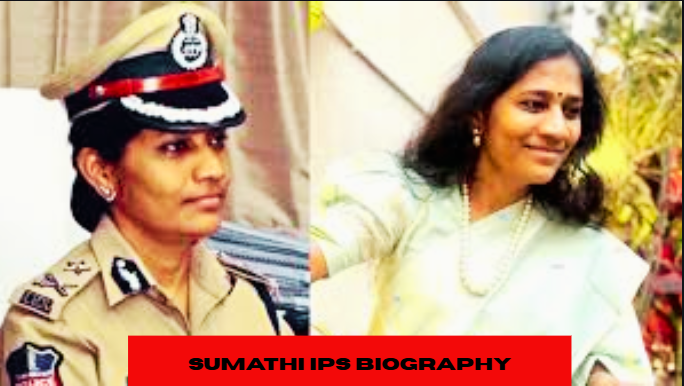
Who Is Sumathi IPS? There are police officers who manage from behind desks, and then there are officers like B. Sumathi — who stand alone at a city bus stop at 2 a.m. in plain clothes, watching, observing, and documenting what women face every single night in India’s urban spaces.
That image alone tells you something meaningful about who she is.
B. Sumathi is a senior Indian Police Service (IPS) officer of the 2006 batch, currently serving as the Commissioner of Police for the Malkajgiri Commissionerate in Telangana. As of May 2026, she holds one of the most operationally demanding police roles in the state — overseeing a densely populated urban jurisdiction on the outskirts of Hyderabad.
But beyond her rank and title, Sumathi has built a reputation over nearly two decades for something rarer in institutional policing: genuine field engagement. She is known as an intelligence strategist, a women’s safety advocate, and an officer who has — more than once — stepped out of the uniform and into the crowd to understand ground realities firsthand.
Sumathi IPS Biography
| Detail | Information |
|---|---|
| Full Name | B. Sumathi |
| Known As | Sumathi IPS |
| IPS Batch | 2006 |
| Cadre | Telangana (formerly Andhra Pradesh) |
| Current Position | Commissioner of Police, Malkajgiri Commissionerate (as of May 2026) |
| Nationality | Indian |
| Profession | Indian Police Service (IPS) Officer |
| Known For | Women’s Safety, Intelligence Work, Field-Level Policing |
| Religion | Not publicly disclosed |
| Net Worth | Not publicly confirmed |
| Social Media | Instagram: @sumathiips |
Early Life and Background
Detailed personal background information about B. Sumathi — including her birthplace, parents, early upbringing, and family history — has not been extensively covered in public records or media profiles. This is fairly common for IPS officers who prefer to keep their private lives separate from their professional identity.
What the arc of her career does reveal, however, is someone who likely developed an early and genuine concern for public order and social justice. Cracking the IPS examination is among the most competitive academic and intellectual achievements in India, and those who reach it typically bring years of focused preparation and a clear sense of purpose.
Her work in intelligence and women’s safety — areas that require both analytical thinking and empathy — suggests a professional orientation that was shaped well before she rose to her current rank.
Her ethnicity, tribe, and specific regional origin have not been publicly disclosed, and it would not be appropriate to speculate without verified information.
Education
B. Sumathi’s specific educational qualifications have not been prominently featured in public records or verified media sources. What is known is that she successfully cleared the UPSC Civil Services Examination and was selected for the Indian Police Service in the 2006 batch — a process that demands exceptional academic preparation, analytical ability, and a thorough understanding of governance, law, and public administration.
The IPS selection process itself is considered one of the most rigorous in the country, making any officer who clears it a highly educated professional by any standard.
Career Journey: Nearly Two Decades of Purposeful Policing
Starting Out — A Different Kind of Officer
Sumathi’s entry into the IPS in 2006 marked the beginning of a career that would be defined not just by promotions and postings, but by a consistent willingness to do things differently.
One of the earliest known examples of her distinctive approach dates back to her early days as a Deputy Superintendent of Police (DSP) near Kazipet railway station — nearly 25 years before her 2026 posting. At that time, she reportedly conducted a field exercise in plain clothes to assess the safety challenges women faced in public spaces. It was an unconventional move for a junior officer, and it foreshadowed the kind of policing philosophy she would carry throughout her career.
Intelligence Work and Strategic Policing
Over the course of her career, Sumathi developed a strong reputation as an intelligence strategist within Telangana’s police structure. Intelligence-based policing — which relies on gathering and analyzing information to prevent incidents rather than merely responding to them — requires patience, discretion, and an ability to read situations accurately.
Her work in this domain placed her among the more analytically driven officers in the state, distinguishing her from colleagues focused purely on law enforcement operations.
Making History in Telangana Police
Sumathi has been recognized as a trailblazer within Telangana’s law enforcement community. She has made history multiple times throughout her career, though specific details of individual milestones are not all uniformly documented in public sources. Her progression to the role of Commissioner of Police — one of the highest field-level positions in the state’s police hierarchy — is itself a significant achievement, particularly for a woman in a profession that has historically been dominated by men.
The Malkajgiri Commissionerate
As of May 1, 2026, Sumathi serves as the Commissioner of Police for the Malkajgiri Commissionerate in Telangana. Malkajgiri is one of the most populous constituencies in India and covers a sprawling urban and semi-urban jurisdiction adjacent to Hyderabad. Managing law and order, crime prevention, and public safety in such an environment requires both administrative competence and active community engagement — both of which Sumathi has demonstrated throughout her career.
Leadership Style: When the Commissioner Becomes the Citizen
Perhaps the most telling indicator of Sumathi’s leadership approach is what she did in 2026 — and what it echoes from 25 years earlier.
In a widely discussed operation, the Malkajgiri Commissioner conducted a late-night, field-level safety assessment at the Dilsukhnagar bus stop in Hyderabad. Dressed in plain clothes, she stood at the bus stop between 12:30 a.m. and 3:30 a.m., observing public behavior without identifying herself as a police officer.
What she witnessed was striking. Multiple men allegedly approached her with inappropriate remarks and questions. Many of them appeared to be under the influence of alcohol or other substances, according to police sources. Around 40 individuals were identified during the exercise and were later counselled by the police.
The purpose was straightforward but powerful: to understand, from the perspective of an ordinary woman, what public spaces actually feel like at night. Not from reports. Not from statistics. From standing there.
The fact that she had conducted a nearly identical exercise as a junior DSP near Kazipet railway station roughly 25 years earlier makes this even more significant. It raises a question she was clearly asking herself: after 25 years, has anything changed for women on the streets at night?
That kind of institutional self-examination — using one’s own rank to generate real-world data about social conditions — is rare in any law enforcement context, and it has earned Sumathi considerable appreciation from both colleagues and the public.
Contributions to Women’s Safety
Women’s safety in public spaces is one of the most persistent and complex challenges in Indian urban policing. It requires more than reactive enforcement — it demands an understanding of how women actually experience public spaces, what deters them, and what makes them feel unsafe.
Sumathi’s approach to this challenge has been distinctly experiential. By putting herself in the position of the people she serves — literally standing at a bus stop in the middle of the night — she generates insight that no official report can replicate.
Her initiative at Dilsukhnagar was also aimed at public awareness. The visibility of such an operation sends a message not just to potential offenders, but to women navigating the city at night: that their safety is not an abstract policy concern, but something a senior officer is willing to physically investigate at 3 a.m.
Peronal Life
B. Sumathi has maintained a clear boundary between her professional identity and personal life. Information about her husband, children, or family background is not publicly available through verified sources. This is consistent with how many senior IPS officers manage public visibility — particularly women officers who often navigate heightened scrutiny in public life.
Her personal contact details are not publicly listed. Those seeking official communication with the Malkajgiri Commissionerate would do so through official police channels.
Net Worth
Sumathi IPS’s personal net worth is not publicly confirmed. As a senior IPS officer, her income is drawn from government salary scales applicable to her rank and seniority — a structure that is publicly defined but varies with allowances, postings, and years of service. No credible external source has reported specific financial figures, and any estimates circulating informally should be viewed with appropriate skepticism.
Social Media Presence
Sumathi IPS maintains a presence on Instagram, where she can be followed at:
- Instagram: @sumathiips
Her Instagram account provides a window into her professional activities, public engagements, and initiatives related to her policing work.
Conclusion
What makes B. Sumathi stand out in a field defined by hierarchy and procedure is her persistent refusal to police from a distance. Two and a half decades into her career, she is still doing what she did as a junior DSP — going out into the field, removing the uniform, and asking: what is the actual experience of the people I am supposed to protect?
In an era when institutional credibility is often earned through visibility and performance rather than genuine engagement, Sumathi’s approach is a meaningful counterexample. The Dilsukhnagar operation was not a public relations exercise — it was a diagnostic one. And the fact that she found conditions not dramatically different from what she observed 25 years ago makes it both a personal observation and a quiet indictment of how slowly some things change.
Her career is still unfolding, and as Commissioner of one of Telangana’s most significant jurisdictions, the impact of her work will continue to be watched closely — both by those inside the force and by the communities she serves.
FAQs
1. Who is Sumathi IPS? B. Sumathi is a senior Indian Police Service officer of the 2006 batch, currently serving as the Commissioner of Police for the Malkajgiri Commissionerate in Telangana as of May 2026. She is known for her work in women’s safety and intelligence-based policing.
2. What did Sumathi IPS do at Dilsukhnagar bus stop? In 2026, Sumathi conducted a plain-clothes field assessment at Dilsukhnagar bus stop between 12:30 a.m. and 3:30 a.m. to personally assess the safety challenges women face in public spaces at night. Around 40 individuals identified during the exercise were subsequently counselled by police.
3. What is Sumathi IPS known for professionally? She is widely recognized as an intelligence strategist, a women’s safety advocate, and an officer with a distinctive hands-on, field-level approach to policing that has set her apart throughout her career in Telangana.
4. Is Sumathi IPS on social media? Yes. She maintains an Instagram account at @sumathiips.
5. What is Sumathi IPS’s current posting? As of May 1, 2026, she serves as the Commissioner of Police for the Malkajgiri Commissionerate in Telangana, one of the state’s key urban police jurisdictions.

Samuel Akinsola is a biography writer and researcher dedicated to uncovering inspiring life stories. He creates well-researched profiles that highlight achievements, challenges, and lasting legacies.