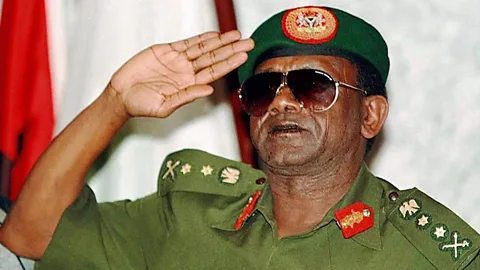
Few names in Nigerian history generate as much argument as Sani Abacha. To some, he was a strongman who brought a degree of economic stability and regional clout during a turbulent era. To many others — particularly those who lived through his five-year military dictatorship — he remains a symbol of authoritarian ruthlessness and staggering corruption. Whatever position one holds, his impact on Nigeria is undeniable: he transformed the country’s institutions, reshaped its politics, and left behind billions of dollars’ worth of controversy that governments are still untangling decades after his passing.
Sani Abacha Biography
| Full Name | Sani Abacha |
|---|---|
| Date of Birth | 20 September 1943 |
| Place of Birth | Kano, Nigeria |
| Nationality | Nigerian |
| Ethnicity | Kanuri (ancestrally from Borno State) |
| Religion | Islam |
| Occupation | Military Officer, Head of State (1993–1998) |
| Spouse | Maryam Abacha (married 1965) |
| Children | Ten (seven sons and three daughters) |
| Known For | Nigeria’s Head of State 1993–1998; Abacha loot; authoritarian governance; human rights abuses |
Early Life and Background
Sani Abacha was born on 20 September 1943 in Kano, northern Nigeria, though his ancestral roots are in Borno State — he was Kanuri by ethnicity, one of the significant ethnic groups of the Lake Chad basin. His father, Alhaji Abacha Maiduguri, was a respected figure in Kano’s trading community, serving as president of the Northern Traders Amalgamated Union. This gave the family a position of standing in Kano society despite their origins.
Growing up in Kano, the young Abacha was known as quiet and reserved — hardly the bearing of someone who would later rule with an iron fist. He attended City Senior Primary School and then the Provincial Secondary School, which would later be renamed Government College Kano. By his own profile, he was not an exceptional student academically; what he possessed was a sharp, calculating instinct that suited the military world he was about to enter far better than any classroom prize could.
Education and Military Training
Just four days after completing his school certificate in 1962, Abacha enlisted in the Nigerian Army and entered the Nigerian Military Training College (NMTC) in Kaduna. He was then sent to England for further training at the Mons Officer Cadet School in Aldershot, after which he was commissioned as a second lieutenant in 1963. Over the following two decades, he underwent an impressive series of training programmes: the School of Infantry in Warminster, the Command and Staff College in Jaji, Nigeria, the National Institute for Policy and Strategic Studies in Kuru, and an international defence course in the United States. He built his knowledge methodically and relentlessly.
Abacha holds the distinction of being the only Nigerian military head of state to achieve the rank of full general without skipping a rank — a detail his admirers cite as proof of his professional discipline within the system.
Military Career
Abacha’s career was deeply intertwined with every major political shift in Nigeria from the 1960s onward. He participated in the July 1966 counter-coup that removed Aguiyi-Ironsi from power. During the Nigerian Civil War, he served as a platoon and battalion commander on the federal side. By 1975, he had risen to command the 2nd Infantry Division.
His most visible political moment before seizing power himself came on 31 December 1983, when he appeared on national television to announce the military coup that overthrew the elected government of President Shehu Shagari. His measured, deliberate delivery on that broadcast — listing charges of corruption and mismanagement — made him a nationally recognisable face for the first time. General Muhammadu Buhari became head of state, with Abacha as a key figure in the new order. When Babangida subsequently overthrew Buhari in 1985, Abacha retained his position and became Chief of Army Staff, then Minister of Defence in 1990.
Head of State: 1993–1998
The political crisis of 1993, triggered by Babangida’s annulment of the June 12 presidential elections widely believed to have been won by Moshood Abiola, created the conditions for Abacha’s takeover. On 17 November 1993, Chief Ernest Shonekan of the interim government stepped down — whether voluntarily or under pressure remains a matter of historical debate — and Abacha assumed power without a single shot fired.
His five years in office were defined by a paradox that continues to challenge historians. On one hand, his administration recorded some notable economic indicators: foreign exchange reserves grew from around $494 million in 1993 to approximately $9.6 billion by mid-1997. External debt fell from $36 billion to $27 billion. Inflation was reduced from 54 percent to around 8.5 percent. Infrastructure projects were carried out through the Petroleum Special Trust Fund, which delivered roads, schools, water supply systems, and health facilities across the country.
On the other hand, the methods of governance were deeply authoritarian. Political parties were banned. The press was harassed and shuttered. Democratic activists, civil society leaders, and political opponents — including Moshood Abiola, Olusegun Obasanjo, and Nobel laureate Wole Soyinka (who fled into exile) — were imprisoned or charged with treason. The execution of environmental writer Ken Saro-Wiwa and eight other Ogoni activists in 1995 drew international condemnation, led to Nigeria’s suspension from the Commonwealth of Nations, and remains one of the darkest episodes in the country’s post-independence history.
The “Abacha Loot”: Scale and Legacy
After his passing in 1998, investigations revealed a pattern of embezzlement of extraordinary scale. Estimates of funds diverted from Nigeria’s treasury range between two billion and six billion US dollars, funnelled through fake national security funding requests into offshore accounts in Switzerland, Liechtenstein, and elsewhere. Recovery efforts have spanned decades and multiple Nigerian administrations.
Personal Life
Abacha married Maryam Abacha, also from Borno, in 1965. They had ten children together — seven sons and three daughters. A notable and lasting contribution of his wife is the founding of what became the National Hospital Abuja, originally established as a facility for women and children.
Abacha was a man of very few public words. He was known as someone who conveyed authority through silence and action rather than speeches — a contrast to the flamboyant public personas of many African leaders of his era. The tribal markings on his face were a visible marker of his Kanuri cultural heritage.
Frequently Asked Questions
What was Sani Abacha known for?
He is known for his military rule of Nigeria from 1993 to 1998, his authoritarian governance, the large-scale embezzlement of public funds (“Abacha loot”), and the execution of Ken Saro-Wiwa and other activists.
What ethnicity was Sani Abacha?
He was Kanuri, an ethnic group primarily found in Borno State in northeastern Nigeria, though he was born and raised in Kano.
How many children did Abacha have?
He had ten children with his wife Maryam — seven sons and three daughters.
What were some of Abacha’s achievements?
Under his administration, Nigeria’s foreign reserves grew significantly, external debt fell, and infrastructure projects were carried out through the Petroleum Special Trust Fund. He also reorganised Nigeria into six geopolitical zones, a structure that remains in use today.
What happened to the Abacha loot?
Recovery efforts have repatriated billions of dollars from overseas accounts, though the process has been long and contested. In December 2025, Abacha was posthumously awarded an honorary doctorate by Maryam Abacha American University of Nigeria in Kano.

Ademola Olasegun is a Nigerian writer, researcher, and digital media professional with over a decade of experience creating informative content across technology, education, business, lifestyle, and public affairs. Passionate about making complex topics easy to understand, he has built a reputation for producing well-researched articles that combine accuracy, clarity, and practical value for readers. His work focuses on helping audiences stay informed through credible reporting, in-depth analysis, and engaging storytelling.
Throughout his career, Ademola has collaborated with online publications, content platforms, and independent media projects, contributing articles, research reports, and editorial content tailored to diverse audiences. With a strong commitment to fact-checking and evidence-based writing, he continuously explores emerging trends, conducts extensive research, and transforms data into accessible insights. Through his work at JustKnow, Ademola aims to provide readers with trustworthy information that empowers better decisions and promotes lifelong learning.